Inspiring Action through Immersive Science Communication: UZH Glaciologist Visits Canada
This November, geographer and glaciologist Andreas Linsbauer attended a symposium in Banff and met with faculty and students at six universities in Western Canada. At several panels and lectures, Linsbauer discussed how storytelling and immersive science communication can drive public engagement and inspire climate action.
From climate and glacier change to communication
In 2025, the Banff Mountain Film and Book Festival celebrated its 50th anniversary. As this also coincided with the UN’s International Year of Glaciers’ Preservation, the Banff Centre for Arts and Creativity hosted a two-day symposium entitled “Fire and Ice Symposium: The Stories We Tell.” The aim of the symposium was to explore how storytelling can create positive impact and action through the lens of changing ice and wildfire – two topics of particular relevance to Canada. As a sponsor of the Banff Mountain Film and Book Festival, the Swiss Consulate in Vancouver invited Andreas Linsbauer, a glaciologist and senior scientist at UZH, to speak at the symposium about the immersive communication projects he has worked on.
At UZH, Andreas Linsbauer studies how glaciers are affected by climate change, with a focus on translating scientific data into immersive experiences that communicate glacier retreat and its broader impacts. His recent work includes the projects “Expedition 2 Grad” and “VR Glacier Experience,” which let visitors experience the retreat of Swiss glaciers using VR headsets. He also created the “IceAgeCam” on Felsenegg, which offers interactive views of Lake Zurich and allows users to compare Ice Age landscapes of the past millenia with today’s human-driven warming. Another notable project is “Glacier Lifelines,” a VR experience that highlights how glacier loss affects water systems in Central Asia. All these projects were developed in close collaboration with the Zurich University of the Arts (ZHdK), with some elements created together with the Universities of Fribourg and Lausanne.
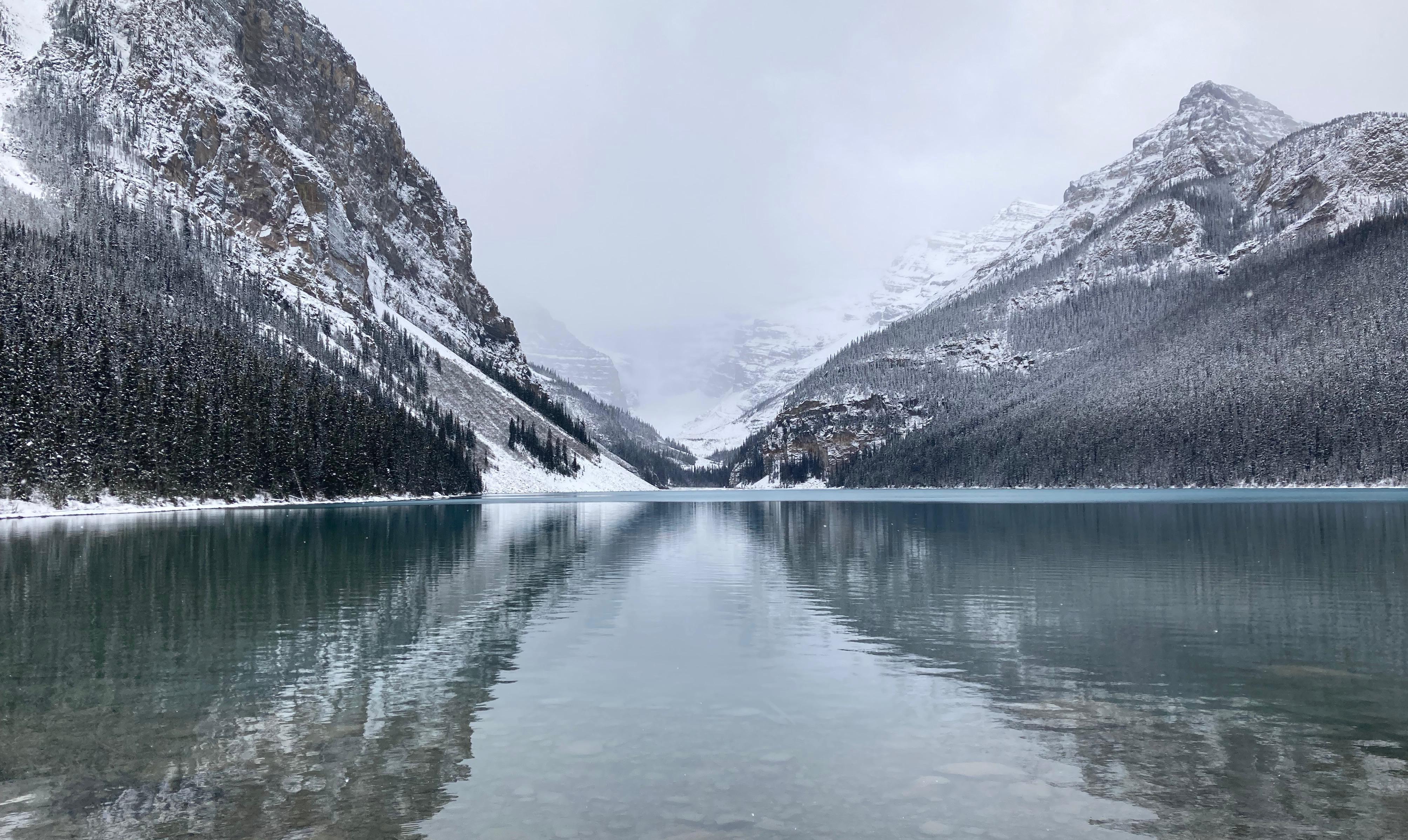
On the first day of the symposium, Andreas Linsbauer was invited to speak at a breakout session about using immersive storytelling, extended reality, and experience-driven design to transform glacier data into emotional experiences that encourage engagement and action. Afterwards, participants had the opportunity to try out the VR headsets. On the second day, he participated in a keynote presentation on the topic of “Adventure” where he and two panelists discussed their experiences as athletes, explorers, and scientists, and how these worlds intersect. The symposium has already sparked interest in two possible future immersive communication projects: one project using VR headsets to visualize glacier retreat at the Columbia Icefield, and another at Lake Louise in Banff National Park similar to the IceAgeCam in Zurich.
-
 A participant tests out a VR headset at the Fire and Ice Symposium in Banff, Canada. Image: Jean-François Delhom
 -
 Andreas Linsbauer speaks at a breakout session on using immersive storytelling in climate communication on the first day of the Fire and Ice Symposium in Banff, Canada. Image: Laura Fairweather
 -
 Andreas Linsbauer speaks at a breakout session on using immersive storytelling in climate communication on the first day of the Fire and Ice Symposium in Banff, Canada. Image: Laura Fairweather
 -
 Andreas Linsbauer takes part in a panel discussion with an adventurer and an explorer, speaking about his experiences as a scientist and how data can be collected in the field on day two of the Fire and Ice Symposium in Banff, Canada. Image: Jean-François Delhom
 -
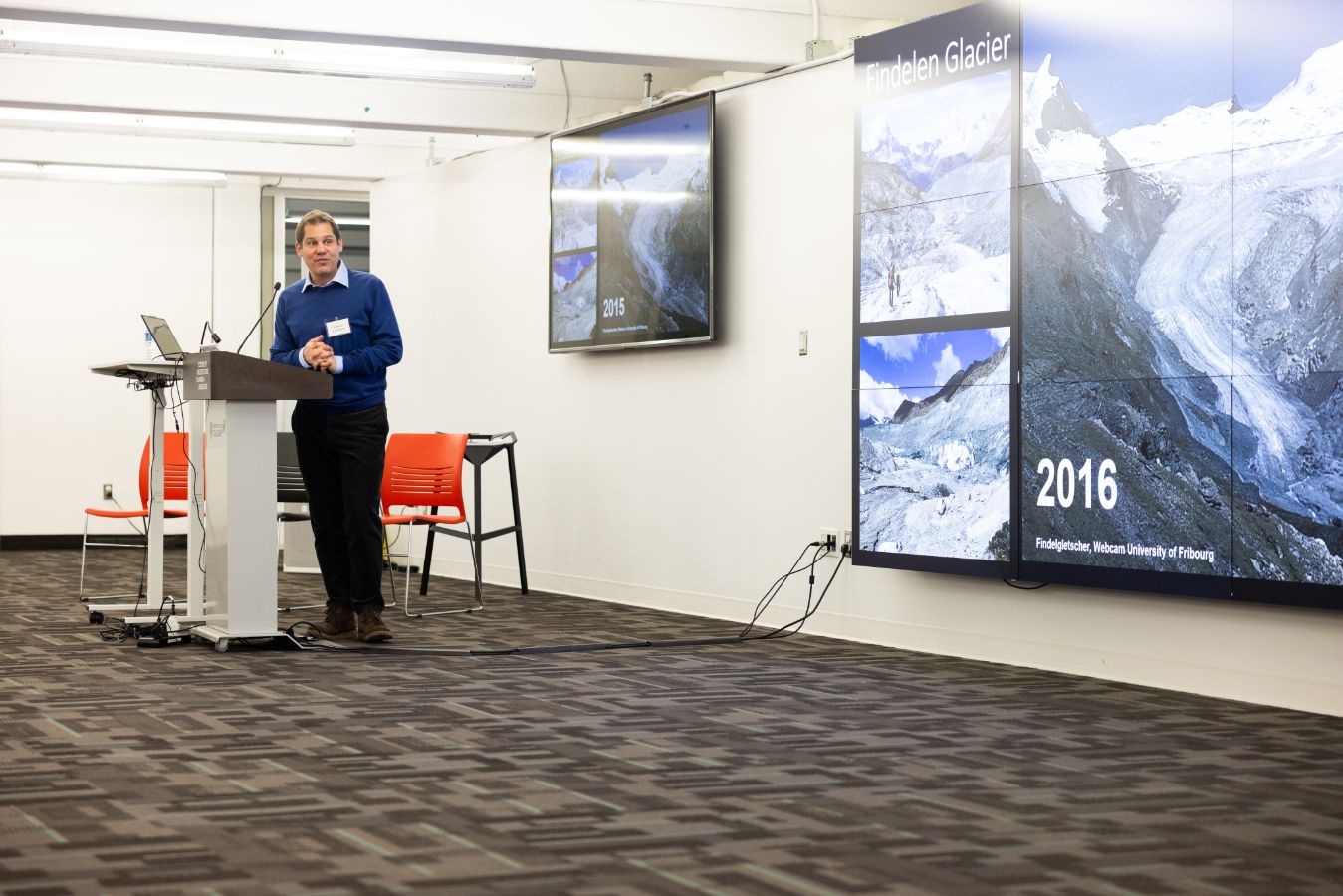 Andreas Linsbauer speaking at the 10-year celebration of the University of Calgary’s Master of Landscape Architecture (MLA) in Calgary, Canada. Image: MLA, UCalgary
 -
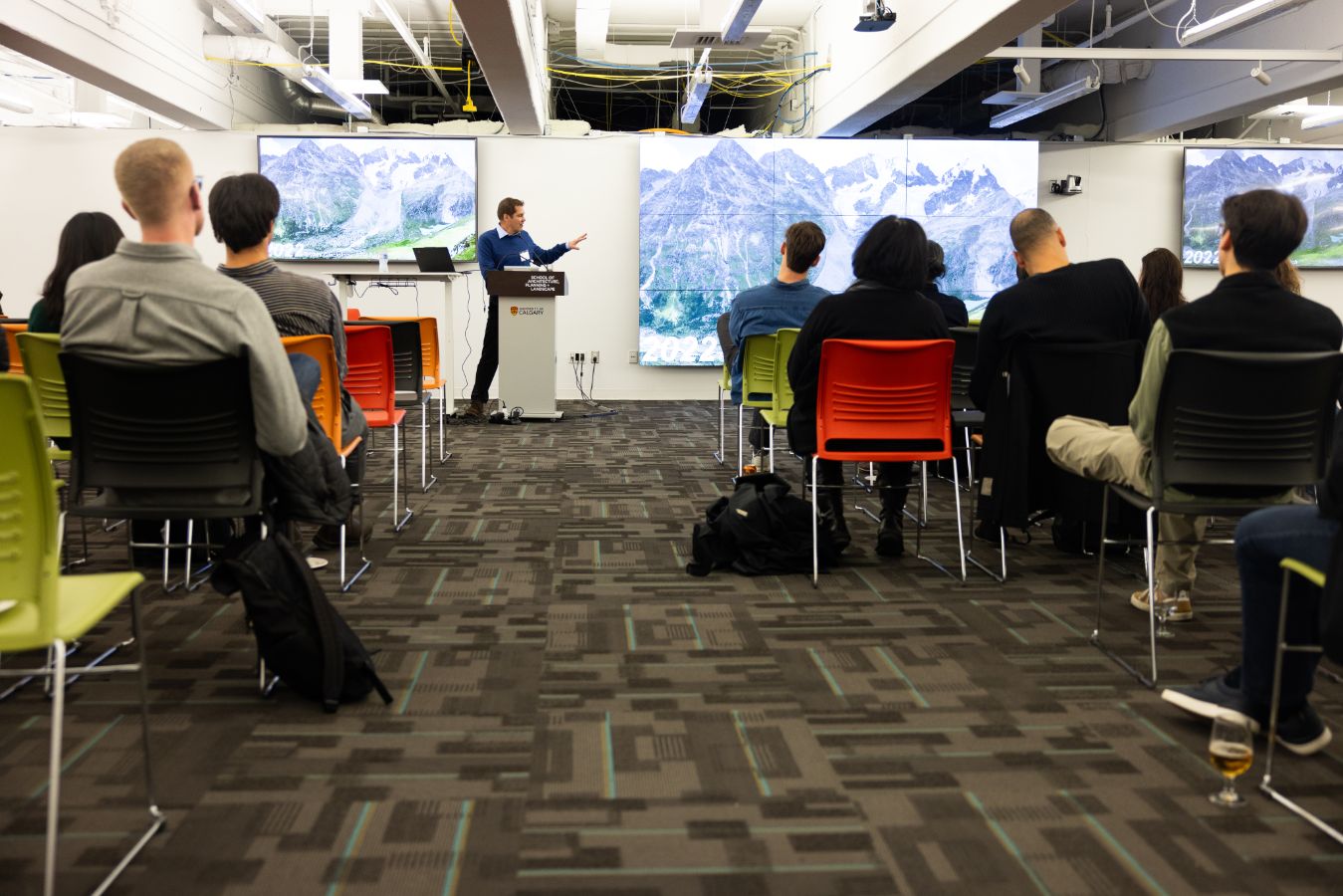 Andreas Linsbauer speaking at the 10-year celebration of the University of Calgary’s Master of Landscape Architecture (MLA) in Calgary, Canada. Image: MLA, UCalgary
Expanding the scope
As an environmental scientist, Linsbauer was hesitant to fly from Zurich to Canada for just a two-day symposium, given the high carbon emissions involved in the travel. But since the consulate offered to organize a multi‑week tour of various universities in Western Canada, the trip’s added value became obvious. The glaciologist had the opportunity to give lectures and meet with students and faculty at the University of Calgary, Mount Royal University, the University of Alberta, the University of Victoria, Simon Fraser University and the University of British Columbia.
During these visits, Linsbauer met with colleagues and researchers not only from science faculties and research labs, but also fine arts, writing and architecture departments. These meetings and activities, including a lecture at the University of Victoria entitled “Science + Art = Action,” demonstrate how interdisciplinary science communication can engage the public and drive change.
In addition to participating in the Symposium in Banff, the lecture and workshop at the University of Victoria was a particular highlight for Linsbauer: “It was special to be invited by the Department of Fine Arts […] because they used my visit to bring science and art together at their university. Although both disciplines are represented on the same campus, there is little collaboration between them. My lecture and the subsequent workshop were an opportunity to sit down together and discuss how art can help science and science can help art, and how they can work together in the future.”
Reinforcing UZH’s strong connection with Canada
Between 2020 and 2024, UZH researchers produced 3,334 co-authored publications with 151 Canadian institutions, with the University of Toronto, University of British Columbia, and McGill University as leading partners. Beyond research, UZH is institutionally connected with McMaster University in Ontario through the Universitas 21 (U21) network and maintains active student exchange programs with University of Victoria, McGill University, Université Laval, York University, Queen’s University and McMaster University.
In 2026, the Banff Mountain Film Festival will go on a world tour, with stops in Switzerland from February to March, including a screening at the Volkshaus in Zurich on March 2, 2026.